Presentation Biology Living habits Infestation Control methods
Home > Infestation > Pupae inside ripe figs: other observers.
Authors: A. COSTA, B. PEYRE.
Photographs: the authors.
All rights reserved.
Pupae inside ripe figs: other observers
In a separate chapter, François DROUET shares his observations of Silba adipata McAlpine pupae inside ripe figs, made in his orchard (Toulon region, French Southeastern Mediterranean coast). In this chapter, other observers report their observations of the presence of pupae in ripe figs. According to the following plan: observations of Alain COSTA, specific observation of Bernard PEYRE.
OBSERVATIONS OF ALAIN COSTA
Alain COSTA, agricultural engineer-consultant and fig grower, Albatera region (Spain). November 13, 2024.
The fig variety planted in the commercial orchards of the Albatera region is 'Colar de Albatera'. It is an early biferous variety, the second harvest of which takes place from July 15-20 to August 15-20. After this, at the tips of the branches (which have very little or no growth), figs that were not picked because they were still immature continue to mature. These figs ripen in a staggered manner until the end of November. When they become soft and dark, they appear healthy, but, in fact, upon opening them, I see that almost all of them have been attacked (in the immature stage) by Silba adipata McAlpine. This is evidenced by the dried brownish or blackish traces of larvae damage in the central cavity, accompanied by more or less developed mold.
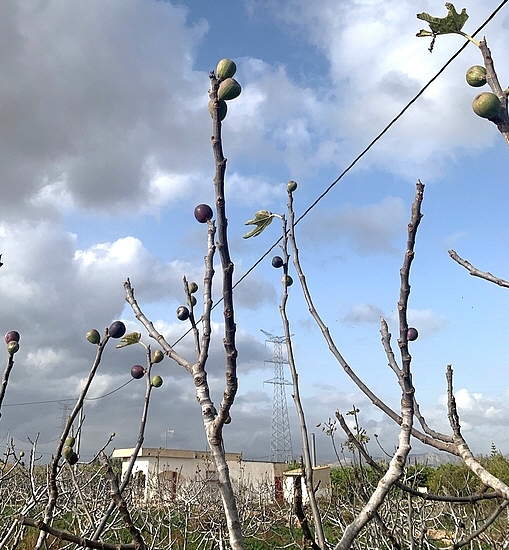
'Colar de Albatera' figs ripening at the tips of the branches after the second harvest (mid-November 2024).
Credit: Alain COSTA.
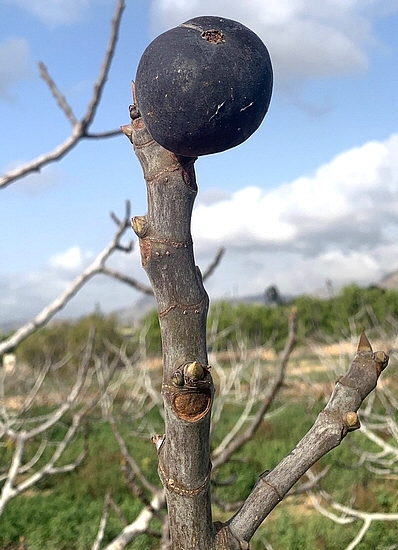
'Colar de Albatera' fig having ripened at the end of the branch after the second harvest (mid-November 2024).
Credit: Alain COSTA.
And I observe that, curiously, the larvae did not leave the figs by boring a hole in the epidermis when they reached full development. I note that they did not move into the whitish parenchyma of the figs, where no trace of galleries is visible. In fact, they remained in the central cavity, within which they either died or began pupation. Thus, I detect one or several pupae in the central cavity of some of the open figs. Pupation is progressing well for some of these pupae, as I also find dead, dried, blackish imagos (which have emerged from the pupae) in some ripe figs. For other pupae, pupation does not reach completion, or the imago dies during the emergence from the pupa, unable to complete its extraction.
For example, below: observation of 4 pupae of Silba adipata McAlpine inside a 'Colar de Albatera' ripe fig, carried out on November 13, 2024.
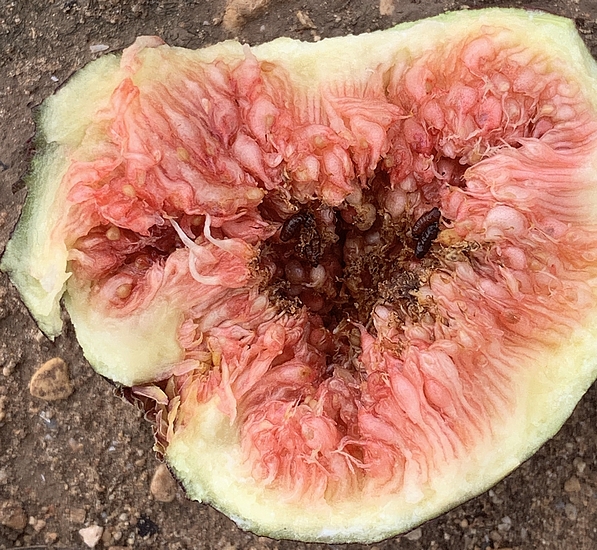
Ripe fig infested with 4 Silba adipata McAlpine pupae; variety 'Colar de Albatera'.
Credit: Alain COSTA.
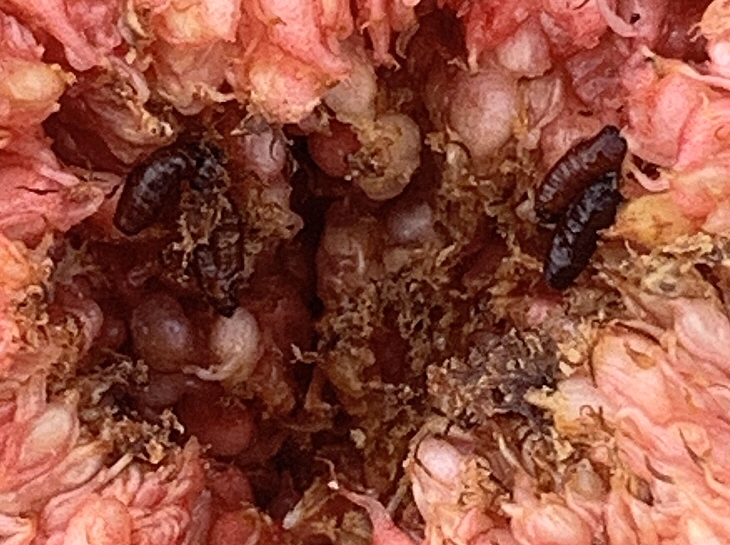
Observation of 4 Silba adipata McAlpine pupae inside a 'Colar de Albatera' ripe fig.
Credit: Alain COSTA.
Notes.
It's easy to verify that the pupae I find in these ripe figs are necessarily the result of egg-laying during the immature stage of the fig. Silba adipata McAlpine eggs are laid 9 to 10 days before the fig begins to turn towards maturity (egg incubation: 3 days + full larva development: 6 to 7 days - biological durations in summer). Thus, in the case of a fully ripe fig (stage generally reached 5 days after the fig begins to turn towards maturity), the egg-laying that resulted in the pupa took place at least 4 to 5 days before the fig began to turn towards maturity. The fig was then in its immature stage (hard and green). This is a minimal delay because the pupa can, of course, be older (and this is generally the case). After oviposition, the fig continued its development, without falling to the ground at the immature stage, unlike most figs infested with Silba adipata McAlpine.
It should be noted that the pupae found in these ripe figs cannot be pupae of Ceratitis capitata Wiedemann (Mediterranean fruit fly). Indeed, since this species does not lay eggs in immature figs, its oviposition dates at the earliest from the day when the fig began to turn towards maturity. The pupa therefore only begins to form in a clearly overripe fig (fig beginning to turn towards maturity + 9 to 10 days in summer, later in autumn). Nor are these pupae of Drosophila suzukii Matsumura, which are half the size and have a different appearance.
SPECIFIC OBSERVATION OF BERNARD PEYRE
Bernard PEYRE, former fig grower and consultant-trainer for commercial fig cultivation. September 17, 2019.
Last week, I made a curious observation on a ripe fig of the 'Bourjassotte Noire' uniferous variety. A pupa was located on the flank of the fig, in a crack of the epidermis (photograph below). I have never encountered such a case, but since it is not possible for a pupa of Ceratitis capitata Wiedemann to form in a fig at the mature stage, it was a pupa of Silba adipata McAlpine.

Pupa on the flank of a ripe fig ('Bourjassotte Noire' variety).
Credit: Bernard PEYRE.
This pupa was empty. The arrangement of the pupa in such a deep crack could suggest that the larva was not in the fig that ripened, but came from outside (falling from above, for example). It would have lodged in the crack and would have transformed there into a pupa, as easily do, according to my observations, the Silba adipata McAlpine larvae above ground (in the most unlikely places).
But the pupa being empty, this means that the larva would have arrived in the crack at least 9 to 10 days before. And the evolution of the concerned ripe fig seems to be at the end of the immature stage (start of softening and changing color) + 5 days. The larva would therefore have arrived in the crack 4 to 5 days before the end of the immature stage, at a time when the crack in the epidermis did not exist. Being emphasized that pupation on the surface of an immature fig is unlikely, although not impossible. One hypothesis would be that the pupa formed inside the fig near the epidermis, in a gallery (maybe close to the exit hole of another larva), and that it appeared outside the fig during the tearing of the epidermis when the fig swelled, in the final phase of ripening.
By enlarging the photograph to the maximum limit, we can see several small holes on the pupa (detail below).

Presence of several holes on a pupa located on a ripe fig flank ('Bourjassotte Noire' variety).
Credit: Bernard PEYRE.
We could deduce that the pupa was attacked by a parasite. I only know one parasite for Silba adipata McAlpine: Pachyneuron vindemmiae Rondani (see details in the chapter "Biological control"). F. SILVESTRI indicates that the female of this parasite searches for pupae on the surface of the ground, between fallen fruits, or at a shallow depth, in the aim of egg-laying. Reference: SILVESTRI F., 1917, Sulla Lonchaea aristella Beck. (Diptera : Lonchaeidae) dannosa alle infiorescenze e fruttescenze del caprifico e del fico, Bollettino del Laboratorio di Zoologia Agraria in Portici, vol.12, pp. 123 -146. The observed pupa clearly flush with the surface of the fig, and is therefore in a position conducive to the attack of this parasite.
But if I examine the photograph above with a magnifier, I quite clearly distinguish 3 holes in an oblique line, and I perceive 4 to 5 others grouped at the top of the pupa. I do not know how to explain these holes. We might suspect that they result from ovipositions of Drosophila suzukii Matsumura in the empty pupa, but this species usually lays its eggs directly into the fig through the epidermis. Unless we imagine that the larvae from the eggs laid in the empty pupe join the infructescence to feed there...
 Top of page Summary