Presentation Biology Living habits Infestation Control methods
Home > Infestation > Dead imagos inside ripe figs: other observers.
Authors: M. LAMARRE, B. PEYRE.
Photographs: the authors.
All rights reserved.
Dead imagos inside ripe figs: other observers
According to the following plan: observations of Margaux LAMARRE, observations of Bernard PEYRE.
OBSERVATIONS OF MARGAUX LAMARRE
Margaux LAMARRE, in charge of technical support in organic arboriculture at CIVAMBIO 66, September 2019.
I often observe pupae and desiccated dead young imagos in ripe figs of the 'Bourjassotte Noire' variety (commercial fig trees orchards, in the Roussillon region, southwest of France). I noticed that the pupae are empty (complete imago emergence), or with the desiccated body of a dead young imago partly protruding out of them (imago emergence not having reached its end).

Black Fig Fly: open pupa and desiccated dead imago inside a ripe fig.
(note the brownish larva damage on the central cavity surface; 'Bourjasotte Noire' variety).

Black Fig Fly: open pupa and desiccated dead imago inside a ripe fig.
(note the brownish larva damage on the central cavity surface; 'Bourjasotte Noire' variety).

Black Fig Fly: open pupa and desiccated dead imago inside a ripe fig.
(note the brownish larva damage on the central cavity surface; 'Bourjasotte Noire' variety).
OBSERVATIONS OF BERNARD PEYRE.
Bernard PEYRE, former fig grower and consultant-trainer for commercial fig cultivation. December, 2024.
I regularly observe pupae and dead young imagos in early-season 'Bourjassotte Noire' figs, and this happens to me from time to time with other varieties. In both cases, the percentage of concerned figs is low. However, during an intervention in a commercial multivarietal orchard in southwest France (2024), I was surprised to observe an unusual massive infestation of ripe figs.
OBSERVATION CONTEXT
The orchard is a plot of approximately 1 hectare. It is 10 years old and consists of about fifteen varieties of fig trees, with one variety per line. The trees are trained using a single wire (6 horizontal main branches), and are irrigated/fertilized using drip cultivation system.
The conditions in this fig orchard are very favorable for growth, with annual shoots most often 1 m or more in length. The vegetation is very dense. For the past five years, the grower has noticed immature fruits drop, attributed to Silba adipata McAlpine. However, since crop losses have been considered manageable, the cultivation is carried out without any phytosanitary treatments, trapping, or preventive removing of infested immature figs. The neighboring plot is a kiwifruit orchard, and this and the fig orchard are bordered by fields and housing estates (some of which have fig trees). These plantations are therefore located on the border between rural areas and urban suburbs.
This year, in addition to the drop of immature fruits (more or less intense, depending on the variety), the grower noticed that most of the ripe figs were internally damaged, sometimes with visible larvae. As a result, he decided not to sell the figs from his orchard. This phenomenon particularly affects the biferous variety 'Dalmatia'. According to my observations, immature figs infested with Silba adipata McAlpine which do not fall to the ground (continuing to develop towards maturity), represent a small percentage of the tree's fig production. In the case of the 'Dalmatia' figs in the studied orchard, this percentage is close to 100%. This is an exceptional phenomenon in terms of its intensity, something I have never observed before.
To get a more precise idea of the attacks, I harvested seven 'Dalmatia' figs on October 10th, at the stage of commercial maturity. The figs, weighing approximately 80 g, were randomly collected from the tree. They showed no external abnormalities or attack symptoms. The fig trees of this variety were in the potential full harvest phase, heavily laden with ripe fruits. These were not sparse, late-season figs.
SILBA ADIPATA McALPINE ATTACKS DIAGNOSIS
For the 7 'Dalmatia' figs to be examined (numbered D1 to D7), I transversely sectioned the basal part for ostiolar region examination under a stereomicroscope, then I longitudinally cut the fig in half for examination and photographs on the table.
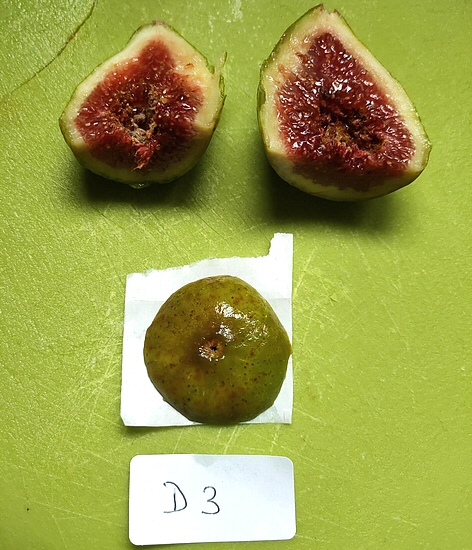
D3 'Dalmatie' ripe fig, before the examinations (naked eye and stereomicroscope).
For all these figs, I definitely identified Silba adipata McAlpine attacks (at the immature stage of the figs – see estimated egg-laying dates, below). The clues leading to this diagnosis are as follows: brownish masses in the infructescence indicating larvae damage, with superinfestation by molds (more or less developed depending on the figs); presence of dried blackish pupae and imagos, the size and appearance of which indicate that they belong to the species Silba adipata McAlpine. I did not observe any small larvae, and I only found a large larva in one case (D1 fig).
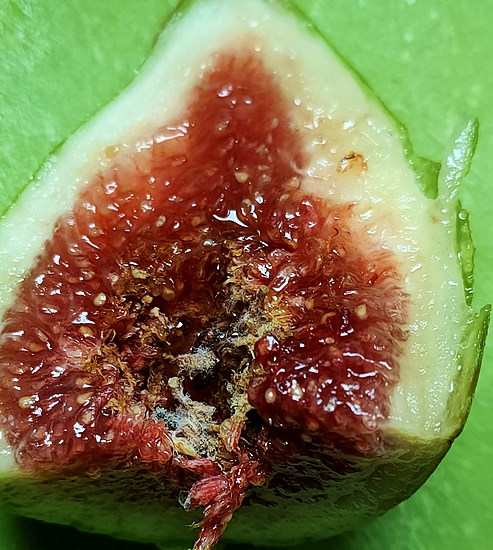
Silba adipata McAlpine larvae damage, and mold, on the surface of the infructescence of a 'Dalmatie' ripe fig.
I also noted: the absence of a purple turn in the infested figs, which is justified by the fact that it is a variety with green skin when ripe; the absence of larvae exit holes on the epidermis, which is explained by the pupations within the figs (the larvae have not left them); the absence of traces of galleries in the parenchyma, which indicates that the larvae have not left the infructescence (it is within this that I found the pupae and the young dead imagos, in a situation more or less distant from the central cavity).
EGG-LAYING DATE / EMERGENCE DATE
It is easy to verify that dead imagos (and empty pupae) found in these ripe figs necessarily result from ovipositions that have been made at the immature stage of these. Silba adipata McAlpine egg-laying takes place 18 to 20 days before the emergence of the imago out of the pupa (eggs incubation: 3 days + larva complete development: 6 to 7 days + nymphosis duration in the pupa: 9 to 10 days - biological durations in summer period). Let us hold 18 days, to obtain the egg-laying date closest to the harvest date. Thus, in the case of 'Dalmatia' figs harvested at the commercial maturity stage (4 days after the fig began to turn towards maturity), the egg-laying of which the empty pupa or the dead imago result took place at least 14 days before the fig began to turn towards maturity (18 days for reaching the emergence outside the pupa minus 4 days of fig evolution to reach the commercial maturity). The figs were then at the immature stage (hard, with white inflorescence). The egg-laying date is at the latest on September 26 (October 10 minus 14 days). It should be noted that the 14 days represent a mininal time because the imago can be older (this is the general case). The desiccated and blackened state of the imagos shows that they are not fresh, and even that the emergence is ancient in the figs at the immature stage. The ovipositions occurred several weeks before September 26.
It might be possible to find in a ripe fig a dead imago presenting a fresh state, the emergence of which would have taken place within the five days separating the complete maturity stage from the date on which the fig began to turn towards maturity. The emergence could then have occurred, either the very day of the discovery of the imago, or during the four days preceding. But I do not know if, during this period, the imago can succeed in its extraction outside the pupa, if we consider the state of the ripe fig infructescence.
It is also necessary to consider the case of possible full pupae. It is not possible to determine whether a full pupa contains a living nymph which will give rise to the emergence of an imago, or a non-viable nymph. But it is easy to verify that the full pupae possibly present in these ripe figs result from ovipositions that have been made at the immature stage of the figs. In the case of a 'Dalmatia' fig at the commercial maturity stage (4 days after the fig began to turn towards maturity), the egg-laying from which the pupa results took place at least 5 days before the date on which the fig began to turn towards maturity (9 days for reaching the pupa stage, minus 4 days). The fig was then at the immature stage This also excludes that pupae can be of the species Ceratitis capitata Wiedemann, the latter not attacking immature figs. The egg-laying date is at the latest on October 5 (October 10 minus 5 days). But the pupae can be older. Thus, if the nymph is in its last formation day in the pupa, the egg-laying took place 9 days before October 5, that is, September 26. And, for the figs harvested on October 10 containing a full pupa with a viable nymph, the egg-laying at the origin of the pupa intervened between September 26 and October 5.
PHOTOGRAPHS ON TABLE
Below, two examples of clear identification on the table of a dried female imago, the size and appearance of which are characteristic of the Silba adipata McApine species.
Example 1 (D3 ripe fig).
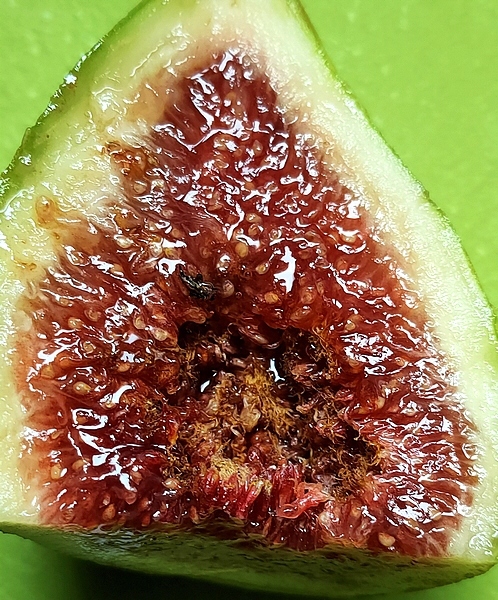
Dead Silba adipata McAlpine imago in the infructescence of the D3 ripe fig.
(at the edge of the central cavity, at the top; on the left of it).
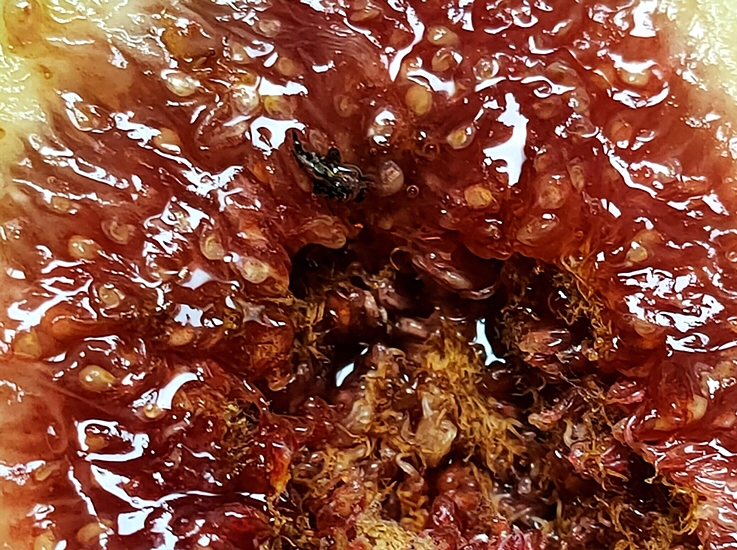
Dead Silba adipata McAlpine imago in the infructescence of the D3 ripe fig.
(at the top, at the edge of the central cavity).
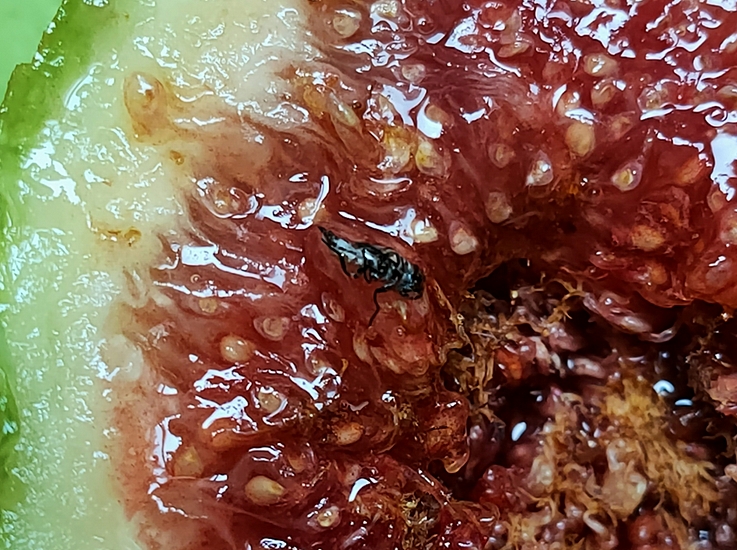
Dead Silba adipata McAlpine imago in the infructescence of the D3 ripe fig.
(the imago was drawn on the surface of the infructescence, to make it more visible).
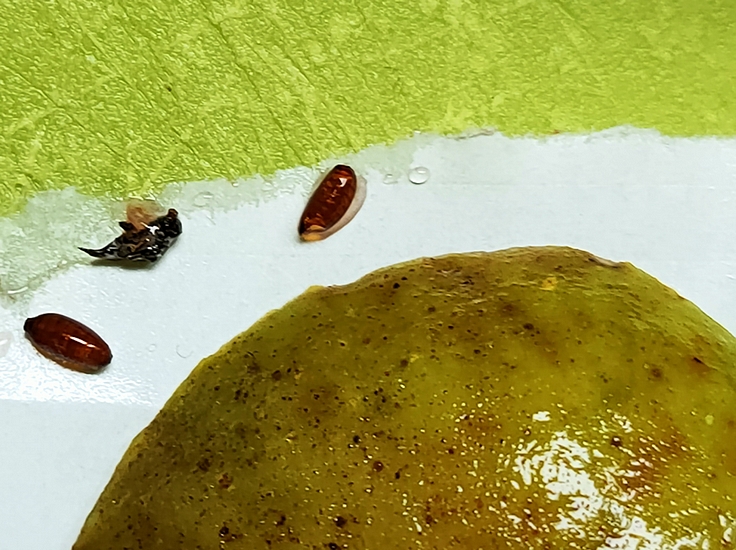
Silba adipata McAlpine dead imago and pupae extracted from the infructescence of the D3 ripe fig.
(appearance and size of the imago and the pupae are characteristic of the species;
the ovipositor, visible because it is out, indicates that it is a female).
Example 2 (D6 ripe fig).
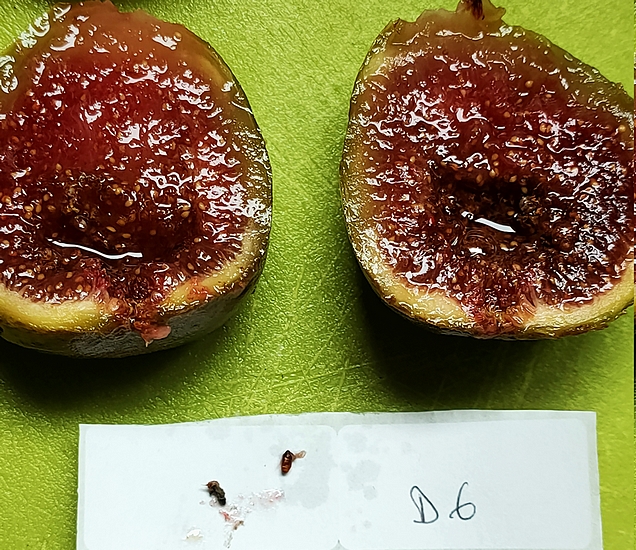
Silba adipata McAlpine dead imago and empty pupa extracted from the infructescence of the D6 ripe fig.
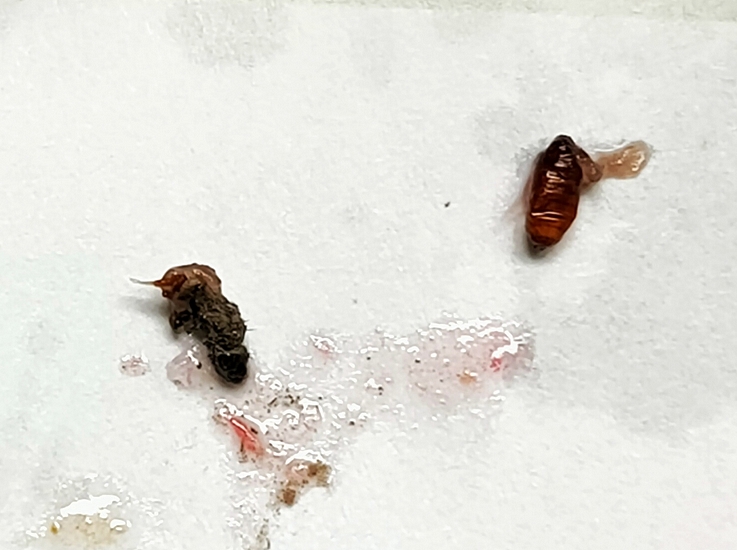
Silba adipata McAlpine dead imago and empty pupa extracted from the infructescence of the D6 ripe fig.
(appearance and size of the imago and the pupa are characteristic of the species;
the ovipositor, visible because it is out, indicates that it is a female).
Convincing clues of Silba adipata McAlpine attacks are sufficiently numerous and clear not to require stereomicroscope analysis. But the latter presents two interests: it will reveal the presence of Silba adipata McAlpine chorions under the ostiolar scales, photographs of which will be used to show the figs producer that the attacks are well signed by Silba adipata McAlpine; it will also make it possible to check the exact nature of certain blackish masses appearing in the figs infructescence.
STEREOMICROSCOPE EXAMINATION
François DROUET undertook stereomicroscope examinations of the ostiolar regions of the ripe figs collected on October 10, as well as of elements extracted from their infructescences (pupae, dried imagos, brownish masses with blackish components - of questionable appearance). I reproduce his observation report below.
For all seven figs, the ostiolar regions examination confirmed Silba adipata McAlpine attacks by the discovery of chorions of this species, ranging in number from two (housed within a single ostiolar scale) to 18 (distributed under nine ostiolar scales), depending on the fig. Chorions and unhatched eggs of Drosophila suzukii Matsumura were also present under the ostiolar scales and in the ostiolar canal, in small numbers. See examples on photographs below.
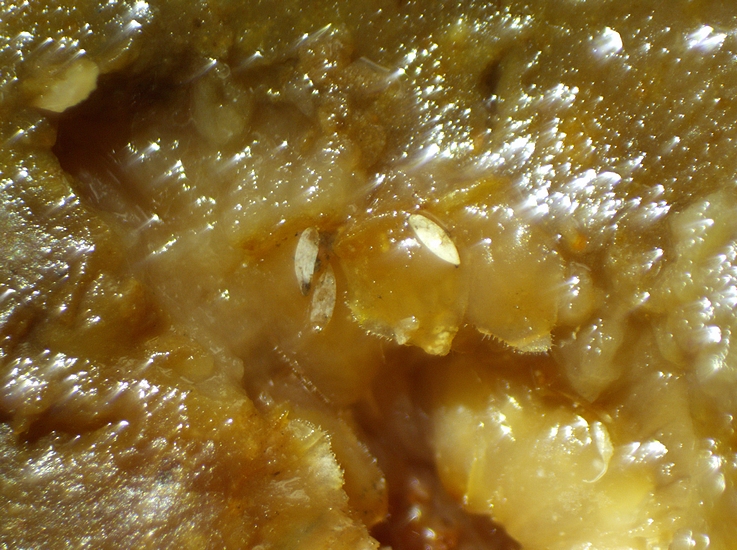
3 Silba adipata McAlpine chorions and 1 Drosophila suzukii Matsumura chorion (down, right), in the ostiolar area of the D3 ripe fig.
(it is a ripe fig, so the ostiolar scales covering the chorions were removed with the pliers, and not cut and raised with the scalpel).
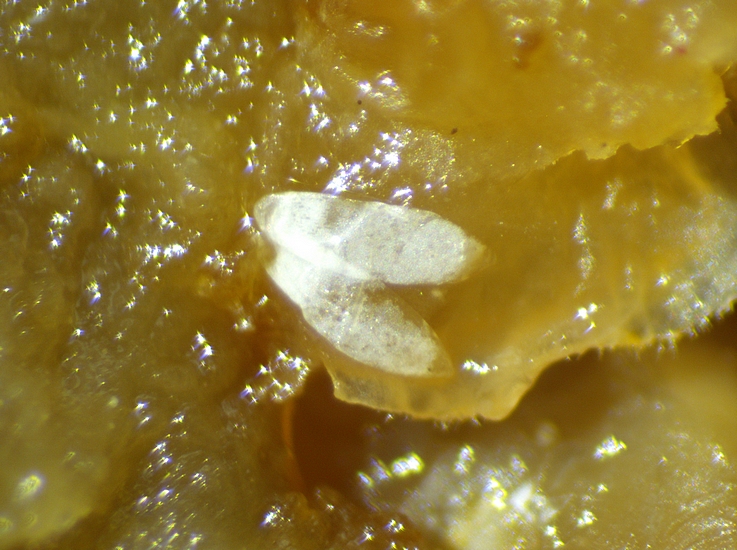
2 Silba adipata McAlpine chorions under an ostiolar scale (pushed, top right) of the D1 ripe fig.
Examination under a stereomicroscope of the brownish masses (with black traces or rounded blackish appendages) extracted from ripe figs infructescence led to the identification of dead, desiccated, and blackened Silba adipata McAlpine imagos (or fragments thereof). In some cases, these were not imagos but dried clusters of flowers remains mixed with parenchyma fragments (see end of the chapter). The imagos and pupae already identified by the photographs taken on the table were also examined, and their belonging to the species Silba adipata McAlpine was confirmed.
Example (photographs below): desiccated female imago extracted from the 'Dalmatia' D3 ripe fig (head turned upside down, proboscis upwards).
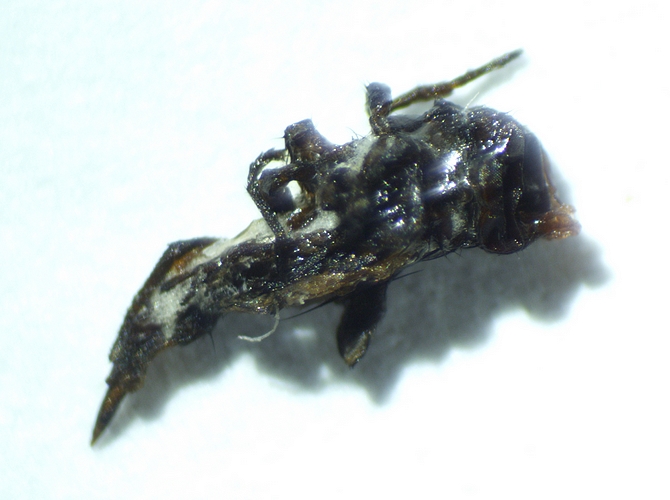
Dead Silba adipata McAlpine imago extracted from the infructescence of the D3 ripe fig.
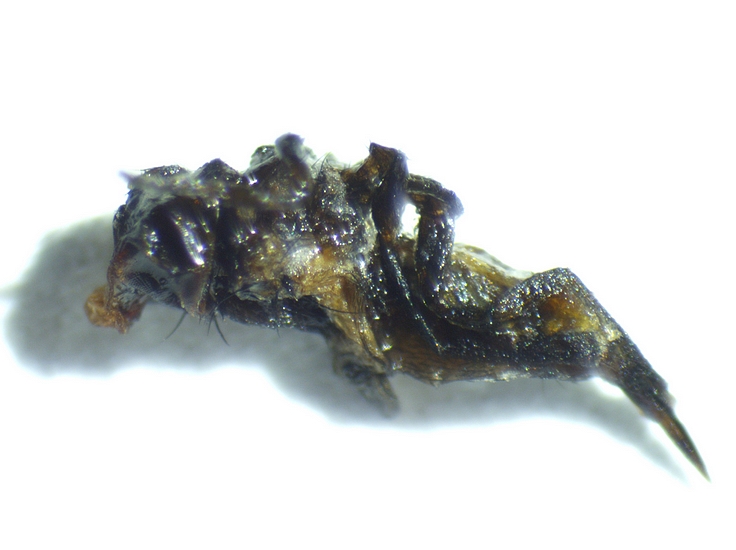
Dead Silba adipata McAlpine imago extracted from the infructescence of the D3 ripe fig (ventral side up, head upside down).
(its state of desiccation shows that the egg-laying dates back several weeks before September 26).
An interesting detail to note: wings of the dead young imago.
For the seven examined 'Dalmatia' ripe figs, as for all the previously examined cases (immature and ripe figs), the dead imagos wings are not unfolded, roughly as they are at the time of emergence from the pupa. The time elapsed before the imagos death did not allow them to swell with hemolymph to unfold. This provides an interesting indication: the imagos rapidly died after the emergence inside the fig (still in its immature state). Indeed, according to the timed observations of François DROUET, it takes 14 to 16 minutes after emergence from the pupa for the wings to be fully unfolded, flat and taut. The stage of wings fully unfolded but not yet well flat and taut is reached 3 minutes earlier. In fact, for the dead imago under examination, the wings having practically not begun to swell, we can estimate that the lifespan in the immature fig was at most of the order of one to two minutes.
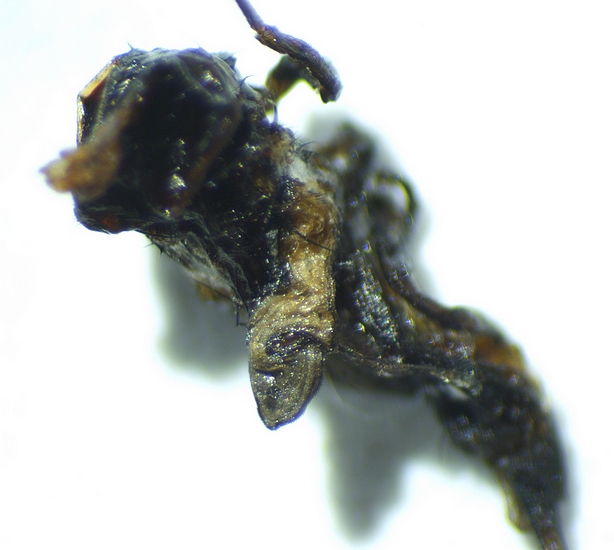
First wing of the dead Silba adipata McAlpine imago extracted from the infructescence of the D3 ripe fig.
(specimen with ventral side up, head turned back; wing not unfolded, detached from the abdomen).
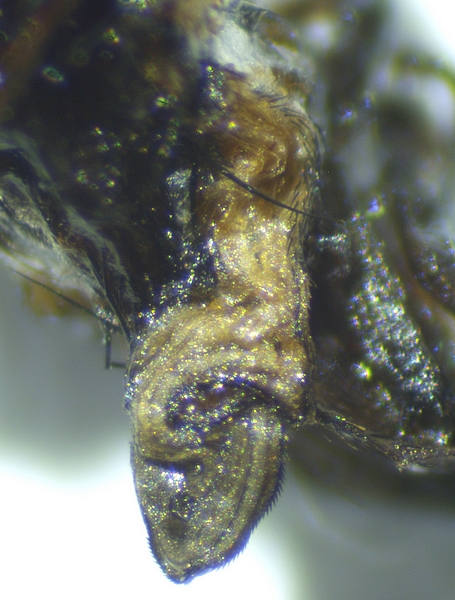
First wing detail of the dead Silba adipata McAlpine imago extracted from the infructescence of the D3 ripe fig.
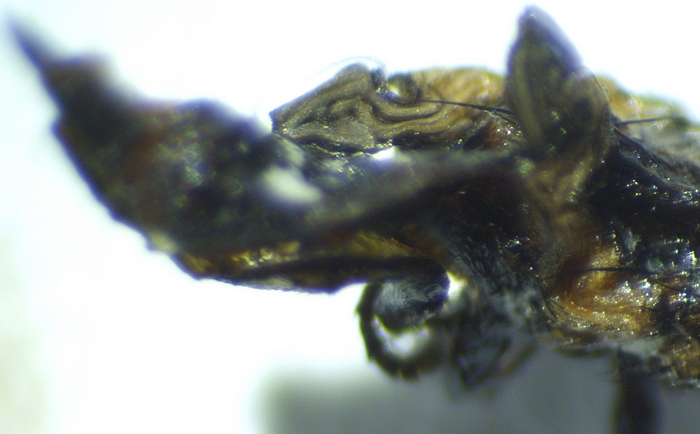
Second wing of the dead Silba adipata McAlpine imago extracted from the infructescence of the D3 ripe fig.
(the wing is not unfolded).
For the record, hereinafter, photograph of a Silba adipata McAlpine imago just after the emergence outside the pupa (general case of a pupa formed out of the fig).
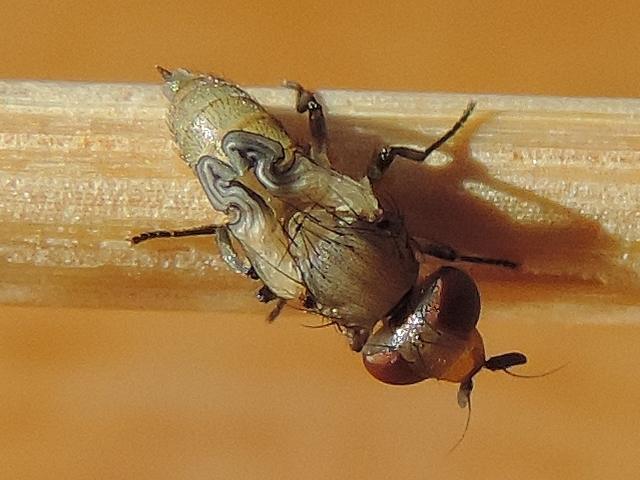
Silba adipata McAlpine imago just after emergence from the pupa.
(note the wings appearance, and the orange ptilinum not yet retracted in the head).
BEWARE OF THE RISK OF CONFUSION
When observing the infructescence with the naked eye (or photographs on table), there is a risk of confusion regarding the nature of certain brownish masses with black traces, or containing a black ball. For these, only examination under a stereomicroscope can determine whether they are a desiccated and blackened remnant of Silba adipata McAlpine imago enclosed in a brownish gangue of infructescence. In many cases, they are dried masses of flowers remains and parenchyma fragments, which reveal a sticky consistency when fragmented and crushed. These masses may contain a fresh (yellowish) or dried (blackish) seed.
Example 1.
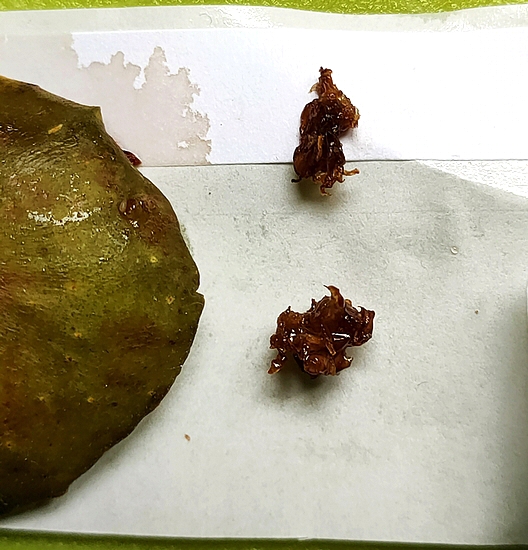
Two brownish masses to be identified, extracted from the infructescence of the D1 ripe fig.
(the mass of the top evokes the form of a dried Silba adipata McAlpine imago in its gangue of infructescence).
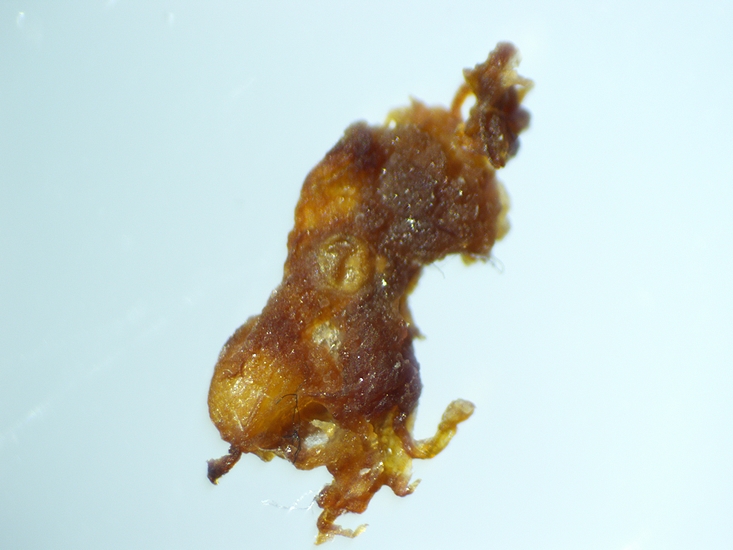
Stereomicroscope examination of a brownish mass with a dried imago appearance, extracted from the infructescence of the D1 fig.
(doubtful appearance during the table examination; doubt removed under stereomicroscope).
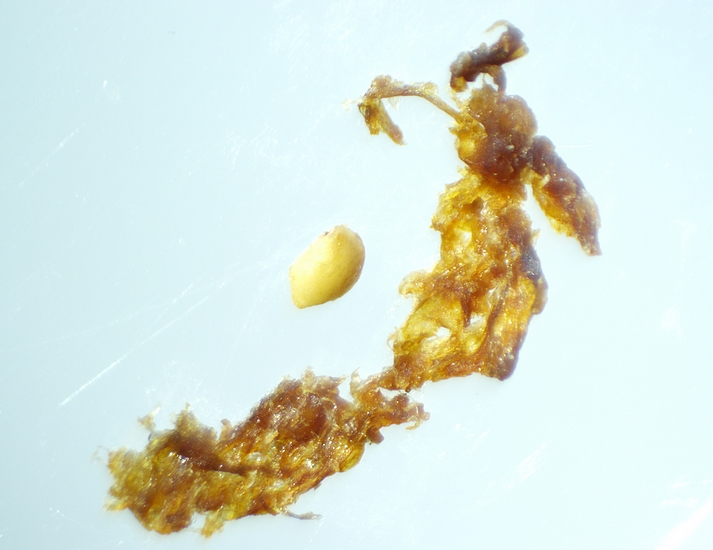
Fragmentation and crushing under stereomicroscope of the brownish mass extracted from the infructescence of the D1 fig.
(it is a desiccated cluster of flowers remains and parenchyma fragments, containing a yellowish seed).
Example 2.
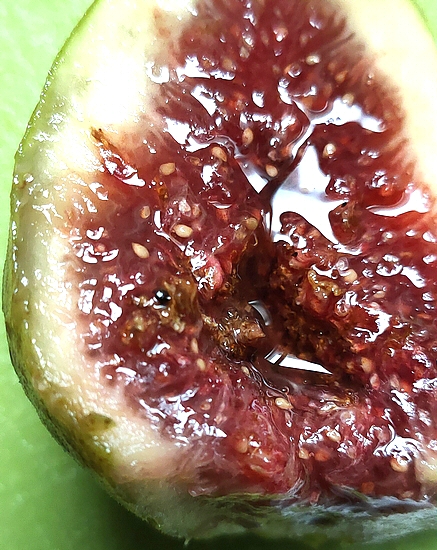
Detection of a blackish rounded mass in the infructescence of the D2 fig.
(on the left in the central cavity).
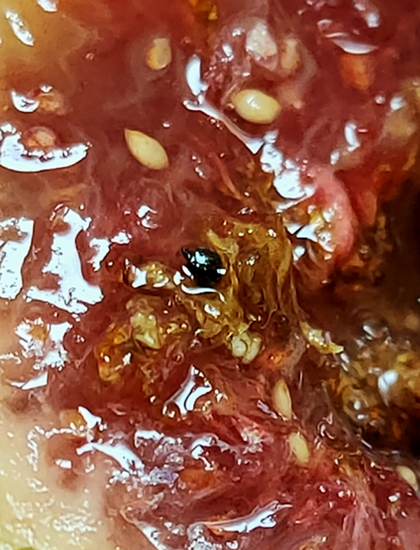
Detection of a blackish rounded mass in the infructescence of the D2 fig.
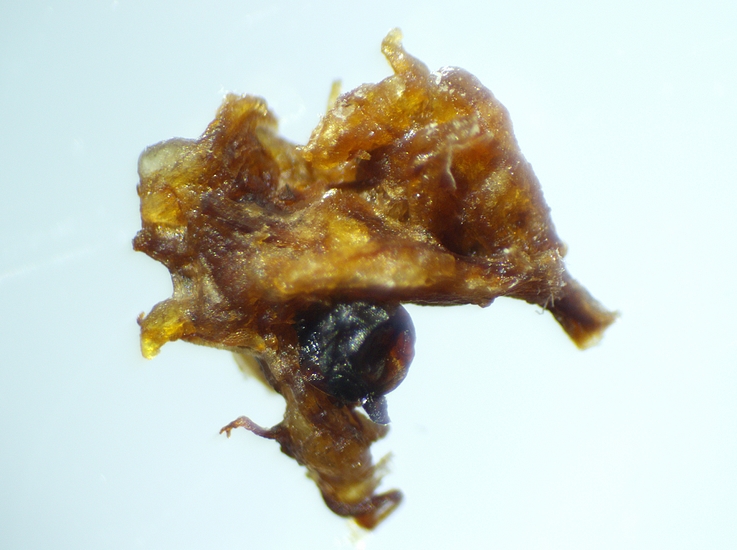
Examination under a stereomicroscope of a brownish mass with a blackish ball, extracted from the infructescence of the D2 fig.
(questionable appearance on table examination; doubt removed under the stereomicroscope).
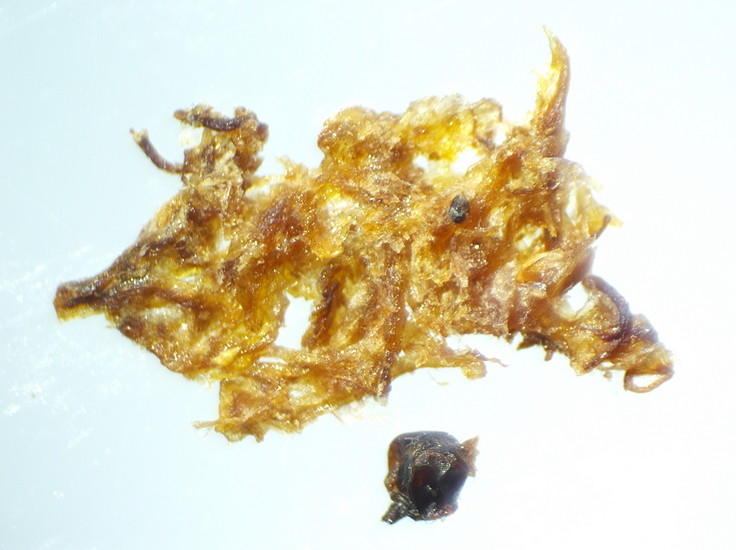
Fragmentation and crushing of the brownish mass with a black ball, extracted from the infructescence of the D2 ripe fig.
(this is a dried mass of flowers remains and parenchyma fragments, containing a dried blackish seed).
Example 3.
A brownish mass with blackish components, of hard consistency, was extracted from the soft infructescence of D4 ripe fig. Examination under a stereomicroscope (photographs below) showed that it was a dried mixture of blackish flowers remains and parenchyma fragments. Upon fragmentation, this mass revealed a firm and sticky consistency.
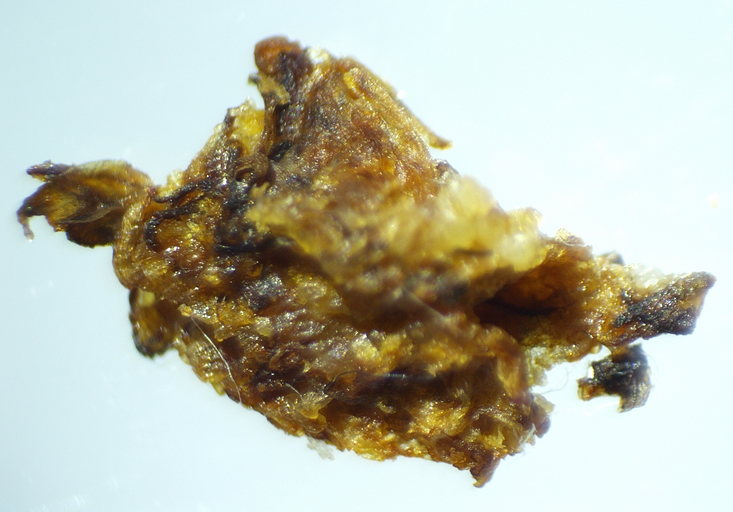
Brownish mass with blackish components, of hard consistency, extracted from the soft infructescence of the D4 ripe fig.
(questionable appearance upon examination on a table; doubt removed under a stereomicroscope).
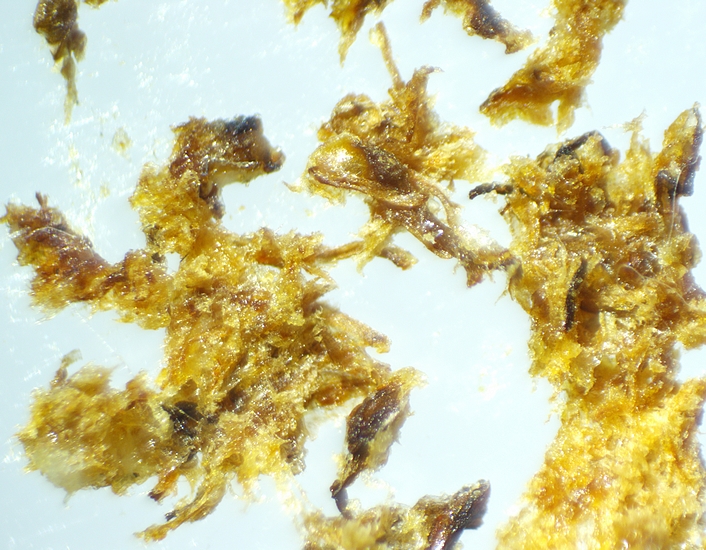
Hard mass extracted from the soft infructescence of the D4 ripe fig: appearance after fragmentation/crushing.
(this is a dried mass of flowers remains and parenchyma fragments, with a sticky consistency when crushed).
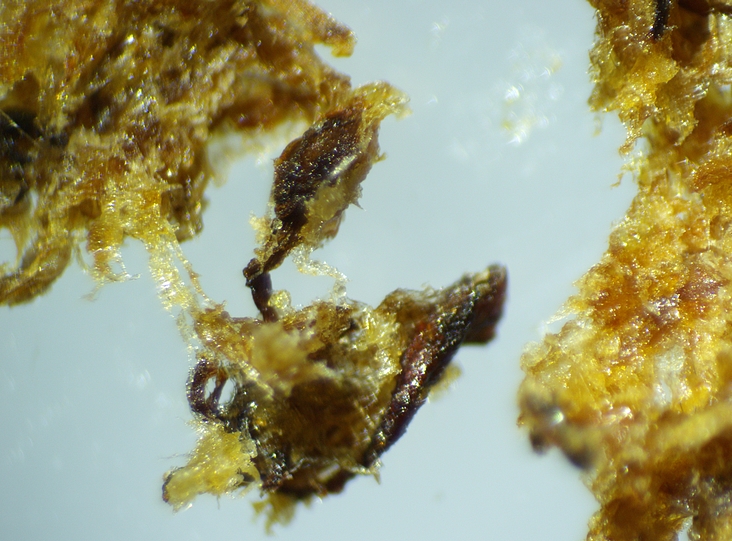
Fragments of the hard mass extracted from the soft infructescence of the D4 ripe fig.
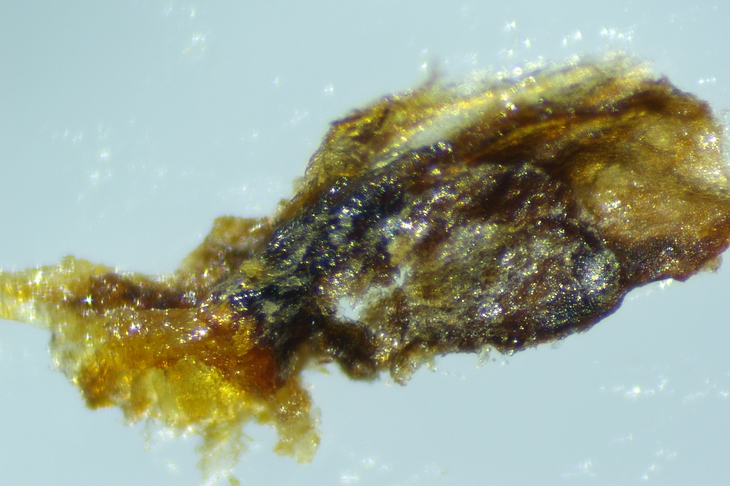
Fragment of the hard mass extracted from the soft infructescence of the D4 ripe fig.
Observations of dead Silba adipata McAlpine imagos in ripe figs by François DROUET are reported in a specific chapter.
 Top of page Summary