




|
Presentation Biology Living habits Infestation Control methods |
||
|
|
||
|
|
Author : François DROUET. |
|
|
|
||
|
The pupa
Chapter plan: pupation (nymphosis), pupa description, pupa opening, pupae depth in the soil.
PUPATION (NYMPHOSIS)
After staying in the fig central cavity, the Silba adipata McAlpine larva leaves it to dig a gallery in the thickness of the whitish parenchyma, under the epidermis. When it has completed its development, it pierces a hole in the skin to get out of the fig. Then It lets herself fall to the ground and buries itself to turn into a pupa. Inside the pupa, the larva turns into a fly: this is the pupation (nymphosis). During my experiments in obtaining adult black fig flies, I noticed in July and August a pupation period of 10 days, sometimes 9. And I observed that most often the first individuals emerging from pupae were males (Toulon region, French southeastern Mediterranean coast). According to the F. SILVESTRI's observations (Napoli region, Italy), the pupation duration is from 9 to 16 days according to the seasons: 10 days in May, 9-10 days in August, 16 days at the end of October and early November. Reference: SILVESTRI F., 1917, Sulla Lonchaea aristella Beck. (Diptera : Lonchaeidae) dannosa alle infiorescenze e fruttescenze del caprifico e del fico, Bollettino del Laboratorio di Zoologia Agraria in Portici, vol.12, pp. 123 -146. It sometimes happens that the pupation takes place inside the fig, and even that the pupation can reach its term there, thus causing the emergence of an imago within the infructescence (which does not survive because it does not manage to get out of the fig...). See specific chapter.
Some Black Fig Fly pupae.
Three Black Fig Fly pupae.
PUPA DESCRIPTION
MORPHOLOGY The Silba adipata McAlpine pupa is almost cylindrical, reddish-brown, with 11 well-marked segments (except the first two, which are difficult to distinguish from each other, but which can nevertheless be delineated at high magnification). The anterior part is a little narrower than the posterior one. The dorsal part is clearly convex, the ventral one a little less. I observe at the posterior end of the pupa the remains of the two spiracles, and at the anterior end those of the two spiracles less visible on the larva. F. SILVESTRI underlines the presence of slight transverse striations between the sculptures of the segments, on the ventral part for all the segments and on the dorsal part for the first and last segments. On the drawing of the dorsal part of the pupa appearing in his aforementioned study, we can see that these are the first three segments, the last segment, and the posterior part of the penultimate segment.
Silba adipata McAlpine pupa.
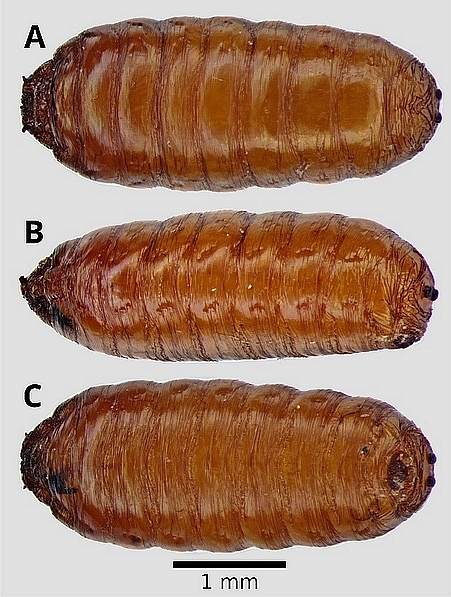
MORPHOLOGICAL DETAILS Photographs provided by JUÁREZ MAYA M. et al. in the November 2024 Biodiversity Data Journal allow us to apprehend some morphological details of the pupa. Reference: JUÁREZ MAYA M., MORALES GALVÁN Ó., VALDEZ CARRASCO J., ILLESCAS SALVADOR D., GUTIERREZ RUELAS J., ILLESCAS RIQUELME C., 2024, Morphology of immature stages of the black fig fly Silba adipata (Diptera, Lonchaeidae), Biodiversity Data Journal 12: e137798. The three photographs below, taken from the aforementioned article (authorized reproduction, CC BY 4.0 license), show the Silba adipata McAlpine pupa, in view: from above (A), lateral (B), from below (C). In C, note at the posterior end (on the right) the blackish remnant of the larva anal area. Also note in A and C the difference in the segments striation highlighted by F. SILVESTRI.
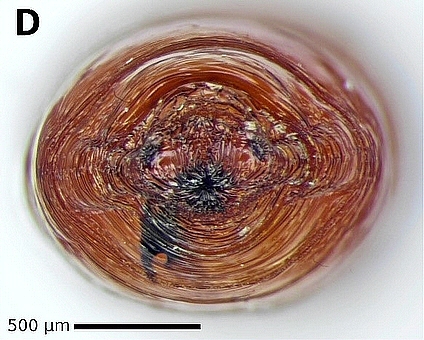
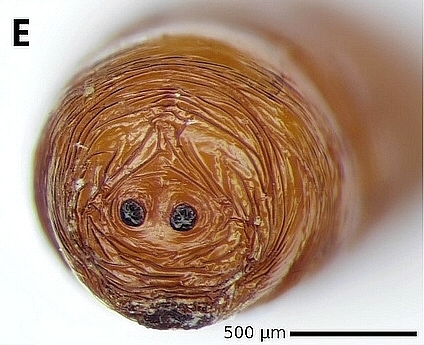
Silba adipata McAlpine: pupa morphology. The two following photographs, also taken from the aforementioned article (authorized reproduction, CC BY 4.0 license), show the anterior (D) and posterior (E) surfaces of the Silba adipata McAlpine pupa. Note the blackish elements on the front side: the remnant of the exit orifice of the larva cephalic capsule; above this, the remains of the two anterior spiracles; at the bottom left, the pharyngeal armature abandoned in the pupa during nymphosis (as well as the mandibles). On the back side, note: the remains of the two posterior spiracles; at the very bottom, the blackish remnant of the larva anal area.
Silba adipata McAlpine pupa: front side.
Silba adipata McAlpine pupa: back side.
SIZE The size of the pupae that I have observed is about 4 mm long and 1.8 mm wide. Some were a little smaller. My observations are consistent with the measurements made by F. SILVESTRI who, for a much larger number of pupae, indicates 3.8 to 4 mm long and 1.7 to 1.9 mm wide. Reference: SILVESTRI F., 1917, Sulla Lonchaea aristella Beck. (Diptera : Lonchaeidae) dannosa alle infiorescenze e fruttescenze del caprifico e del fico, Bollettino del Laboratorio di Zoologia Agraria in Portici, vol.12, pp. 123 -146. Nihat SCHEWKET, who studied the Black Fig Fly in the early 1930s in western Anatolia (Türkiye), observed a length of 3.5 to 4 mm for the pupa. Reference: SCHEWKET N., 1934, Die Feigeninsekten und die wesentlichsten Ursachen der Feigenfruchtfaüle, Anzeiger für Schädlingskunde, 10 (10), 118-119. Black Fig Fly pupa size (4 mm long).
Black Fig Fly pupa size (4 mm long).
COMPARISON WITH THE PUPA OF CERATITIS CAPITATA WIEDEMANN Having simultaneously bred medflies (Ceratitis capitata Wiedemann) and black fig flies (Silba adipata McAlpine), I have been able to compare the pupae of the two species. With practice, we easily recognize each other: the pupa of Silba adipata McAlpine clearly appears smaller and less rounded than that of Ceratitis capitata Wiedemann. The latter is slightly longer, much wider, and it generally has a greater width to length ratio. Below, two photographs showing the differences between Ceratitis capitata Wiedemann pupae (on the left) and Silba adipata McAlpine ones (on the right).
Comparing Medfly (on the left) and Black Fig Fly (on the right) pupae.
Comparing Medfly (on the left) and Black Fig Fly (on the right) pupae.
COLOUR The Black Fig Fly pupa changes color as the nymph develops (first whitish, than light brown, and dark brown when the nymph is almost completly developed).
Silba adipata McAlpine: pupa color evolution.
PUPA OPENING
The pupa opens under the push of the imago ptilinum. The opening is made according to preformed dehiscence lines delimiting a cap which opens like a cover. Below, two photograhs showing empty pupae found in the soil.
Silba adipata McAlpine: empty pupa found in the soil.
Black Fig Fly: empty pupa found in the soil.
PUPAE DEPTH IN THE SOIL
For those who would imagine Black Fig Fly control methods destroying the pupae, or killing the nymphs inside the pupae, it is useful to know how deep are the pupae in the soil. I have observed the difficultty for the larvae to bury themselves in the soil depending on its texture, but I have no personnal observations about the burying depth. Two authors give a response. Filippo SILVESTRI, in its masterful study of the Black Fig Fly (morphology, biology, fig infestation...), published in 1917, indicates that the larvae burrow to a depth of 2 to 10 cm, before starting their pupation. Reference: SILVESTRI F., 1917, Sulla Lonchaea aristella Beck. (Diptera : Lonchaeidae) dannosa alle infiorescenze e fruttescenze del caprifico e del fico, Bollettino del Laboratorio di Zoologia Agraria in Portici, vol.12, pp. 123 -146. Nihat SCHEWKET, who studied the Black Fig Fly in western Anatolia (Türkiye), in the early 1930s, specifies for his part that the larvae burrow to a depth of 3 to 4 cm, before starting their pupation. Reference: SCHEWKET N., 1934, Die Feigeninsekten und die wesentlichsten Ursachen der Feigenfruchtfaüle, Anzeiger für Schädlingskunde, Vol. 10, Issue 10, pp. 118-119. Below, a photograph showing a young imago having emerged from the pupa and reached the surface of the soil. Note that the wings are not yet fully swollen to their maximal length, whereas the upper thorax is already black-colored - we can deduce that the imago came out the pupa at least one quarter of an hour ago.
Silba adipata McAlpine : young imago having emerged from the pupa and reached the surface of the soil.
|
||
