TWO MATED BLACK FIG FLIES OBSERVATION
MATED BLACK FIG FLIES DETECTION
On June 30, 2016, around noon, I was walking around an old bush of the 'Dauphine' variety, with ripe breba figs, trying to spot black fig flies. As I was finishing my inspection, I thought I glimpsed an elongated fly with raised wings and a twisted body, moving in place, on a leaf in the second row of the periphery of the bush, in the shade. Intrigued by this unusual shape and posture, I cautiously approached to observe the fly more closely.
I immediately determined that it was actually two mated black fig flies. To my relative surprise, while mated, they were feeding on a puddle of ripe fig juice (which had dripped onto the leaf from a fig above). I was able to observe them for a little over a minute.
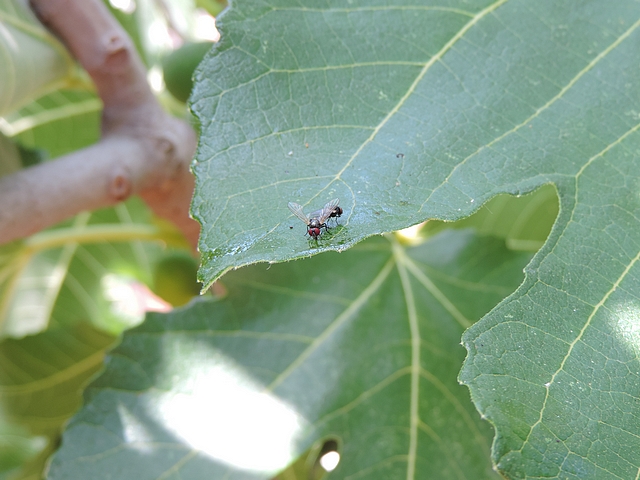
Two mated black fig flies on a fig tree leaf.
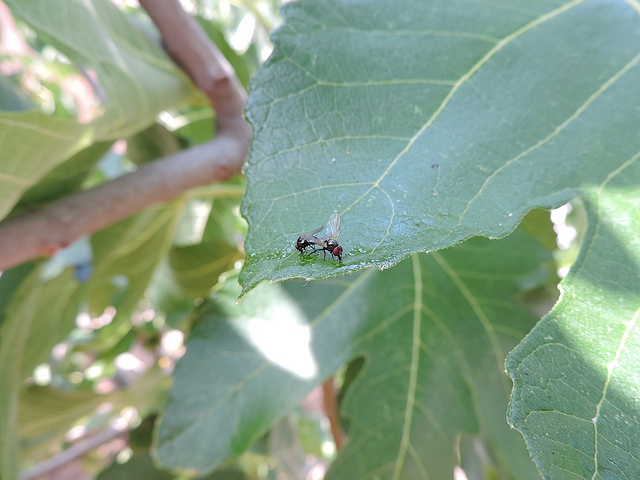
Two mated black fig flies on a fig tree leaf.
COUPLE IN COPULA CONFIGURATION
The coupling position was of the end-to-end type. The two flies were placed at the same level in opposite directions and were joined by the end of their abdomen. One of the two having the wings open and raised, the other the wings closed. I determined in the photographs that the male was the individual with raised wings, and I confirmed that the other was the female.
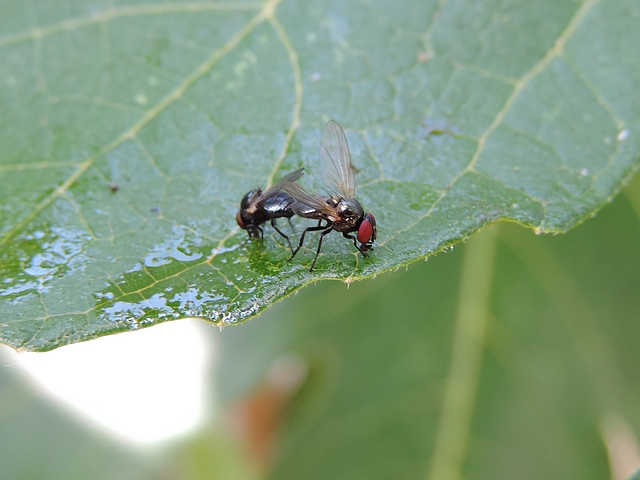
Two mated black fig flies (coupling position: end-to-end type).
In the photograph below, we can identity the male (open raised wings) by its narrow interocular space, and the identification of the female is confirmed by its tightly segmented abdomen end.

Two mated black fig flies on a fig tree leaf (coupling position: end-to-end type).
ABDOMENS ARTICULATION
Upon closer examination of the junction between the two abdomens, I observe that the male's abdomen is positioned above the female's one.
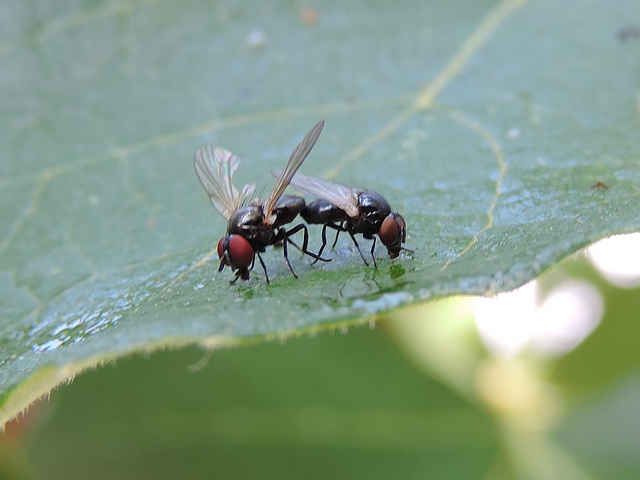
Black fig flies in copula: the male's abdomen (on the left) is attached above the female's one.
COUPLE FEEDING ACTIVITY
The two flies did not move on the puddle of sweet juice at the usual speed of a single fly, but performed slow circular movements almost in place while keeping the wings in the same position. The two bodies joined by the abdomen were most often found in the continuation of one another (photograph below).

Bodies position 1 of two mated black fig flies feeding on a fig tree leaf.
But, sometimes, the movement made them shifted relative to each other, with an angle of an amplitude never larger than 45 ° (photograph below).

Bodies position 2 of two mated black fig flies feeding on a fig tree leaf.
MOVING UP THE FIG TREE LEAF
After about one minute, the male fly turned around and went up the leaf, towards the edge of it, seeming to drag the female who kept the wings closed and who was still in the extension of the male abdomen. I could not determine if the female was really being
dragged or if it was walking backwards.

Two black fig flies in copula going up a fig tree leaf.
COUPLE TAKING FLIGHT
When the couple reached the leaf edge, a few centimeters above their starting point, the male fly spread his wings flat in a cross shape. The female kept her wings folded and her body aligned with the male's, as if she were not intending to fly but simply to remain attached to the male during the flight.

Two black fig flies in copula on the edge of a fig tree leaf, just before taking flight.

Two black fig flies in copula on the edge of a fig tree leaf, just before taking flight.
Then the male took flight, the female still attached to it. I am sure the couple did not split up when it took flight. And it seemed to me that only the male was flying and that the female had remained with its wings closed, the body in the extension of that of the male. I had the impression that a rigid bar was flying away. Note added in 2026: this fleeting observation is confirmed by a couple taking flight photograph provided by B. PEYRE, consultant trainer for the French fig industry (see the second chapter relating to an observation of Silba adipata McAlpine in copula).
I was not able to observe the black fig flies couple beyond it took flight, due to the still very fast flight of the male. Despite half an hour of meticulous scrutiny of the fig tree bush, I could not find the mated flies on the tree or observe them in flight.
SPECIAL OBSERVATION
In the photograph below, we notice that the male fly's right wing is partially damaged. Could this be the result of an in-flight maneuver during mating, suggesting that the latter took place in flight and that the two flies landed on the leaf already mated to feed from the puddle of sugary juice?

Silba adipata McAlpine: couple in copula on the edge of a fig tree leaf.
WHERE DOES SILBA ADIPATA McALPINE MATING TAKE PLACE ?
A PLAUSIBLE HYPOTHESIS
In my many years of intensive observations of Silba adipata McAlpine on various fig trees, at all periods of the season and at any times of the day, I was able once only to see two mated flies of this species. I am therefore convinced that Silba adipata McAlpine mating does not occur on fig trees, and that mated flies of this species only very rarely land on these.
My conviction is reinforced by the responses of the three other main contributors to this website, all experienced Silba adipata McAlpine observers, whom I asked if they had ever observed mating individuals of this species. Alain COSTA (agricultural engineer - consultant and fig producer in Spain), like myself, has only once observed two flies of this species mated on a fig tree, without witnessing the mating itself. Margaux ALLIX (in charge of technical support within the CIVAMBIO 66 producers group) and Bernard PEYRE (consultant trainer for the French fig industry) have never made such an observation. And none of the four of us have ever observed Silba adipata McAlpine mating elsewhere. Note added in 2026: on August 21 of this year, B. PEYRE was able to make the observation of two black fig flies in copula (see chapter reporting this observation).
I have not found in the specialized literature any information on the mating place of the Black Fig Fly (2024). I note in particular that F. SILVESTRI provides no information relating to mating in his masterful study of the Black Fig Fly. Reference: SILVESTRI F., 1917, Sulla Lonchaea aristella Beck. (Diptera : Lonchaeidae) dannosa alle infiorescenze e fruttescenze del caprifico e del fico, Bollettino del Laboratorio di Zoologia Agraria in Portici, vol.12, pp. 123 -146.
And B. I. KATSOYANNOS, who studied in 1981 and 1982 large populations of black fig flies in the island of Chios (Greece), explicitly states that he has not observed any mating in the field, nor in the laboratory. Reference: KATSOYANNOS B. I., 1983, Field observations on the biology and behavior of the black fig fly Silba adipata McAlpine (Diptera, Lonchaeidae), and trapping experiments, Z. ang. Entomol. 95, pp. 471-476.
For me, it follows from the above considerations that a plausible hypothesis is that Silba adipata McAlpine mating occurs during flight.
RELATIONSHIP WITH AERIAL SWARMING
In insects, aerial swarms are generally associated with mating activity, characterized by pair formation in flight. Numerous references, among which I cite: SULLIVAN Robert T., 1981, Insect Swarming and Mating, The Florida Entomologist, vol. 64 (1), pp. 44–65.
I only know one reported swarm observation for Silba adipata McAlpine. It was made on August 20, 1982 by B. I. KATSOYANNOS, while he was studying Lamprolonchaea smaragdi Walker swarming in the Chios Island (Greece). He specifies that the swarm consisted of approximately 20 individuals, and that among the eight individuals he was able to capture in a net was one female. Reference: KATSOYANNOS B. I., 1983, Swarming of Lamprolonchaea smaragdi Walker (Diptera, Lonchaeidae) and a few other Diptera observed in Chios, Greece, Bulletin de la Société Entomologique Suisse, vol. 56, pp. 183 -185.
J. F. McALPINE and D. D. MUNROE have described the swarming behavior for sixteen species of the Lonchaeidae family (which do not include Siba adipata McAlpine). Reference: McALPINE J. F., MUNROE D. D., 1968, Swarming on Lonchaeid flies and others insects, with description of four new species of Lonchaeidae (Diptera), The CanadianEntomologist, vol.100, pp. 1154-1178.
I note that the aerial swarms of these species were all observed at heights between 0.30 m and 2.10 m. For the authors, swarming is traditionally associated with mating, but while most observers agree that these are two sequentially coordinated activities, the degree to which they are linked is the subject of considerable debate. On this topic, the authors provide numerous bibliographic references, from which they retain the following principles.
Swarming is independent of the females presence, but the fact that the swarming onset so often coincides with sexual maturity seems to indicate that it is endogenously linked to sexual factors. Swarming and mating are two independent, though coordinated, behavioral processes. Swarming responds to visual stimuli from markers at relatively long distances, while mating is governed by a proximity mechanism in response to tactile stimuli. An individual within a swarm ceases to belong to it as soon as its courtship and short-distance mating mechanisms are activated - that is, as soon as it approaches and makes contact with a potential mate - and it only rejoins the swarm after dissociating from that mate. The mating process occurs once the mates have landed.
The authors validate these principles for the Lonchaeidae family based, on the whole, on limited personal observations: females are rarely found in swarms of Lonchaeidae individuals, mating has never been observed within them, and a pair of Lonchaea laxa was seen copulating on a leaf near the swarming site.
MY OBSERVATIONS
I have no personal observation of Silba adipata McAlpine swarms. Nevertheless, I regularly observe black fig flies groups flying between two trees in a similar way than that of the swarm described by B. I. KATSOYANNOS. I do not qualify them as aerial swarms because these groups only involve two to three specimens. The group performs repetitive flights, more or less on the horizontal plane and limited to an elliptic space, with an amplitude of about 2 m, at a height of about 1.5 m. The aerial group is rather stationary, but Inside the group the flies permanently keep their very fast zigzaging characteristic flight pattern.
I can observe this phenomenon for long whiles, sometimes more than one hour, in the late afternoon, at dusk. Over the season, I regularly perform this type of observations at two places:between my ‘Bellone’ variety fig tree and an oriental persimmon (in June), and betweem an olive tree and a silky oak, near a hedge, at 30 m from my fig trees (during certain periods of summer). I think that these black fig flies grouped in the air are males waiting for females, or males and females just before mating (or mating).
ABSENCE OF MATING UNDER LABORATORY CONDITIONS
B. I. KATSOYANNOS, who studied large populations of black fig flies on the island of Chios (Greece) in 1981 and 1982, attempted to observe mating behavior of Silba adipata McAlpine in the laboratory. Reference: KATSOYANNOS B. I., 1983, Field observations on the biology and behavior of the black fig fly Silba adipata McAlpine (Diptera, Lonchaeidae), and trapping experiments, Z. ang. Entomol. 95, pp. 471-476.
The author kept the flies that emerged from the pupae in the laboratory in groups of 20 to 50 individuals of both sexes in 30 x 30 x 30 cm cages at 25 °C, with 60–70% relative humidity and natural light from the room's windows. The cages were provided with water and food (yeast hydrolysate, water, and sugar in a 1:4:5 ratio). B. I. KATSOYANNOS also placed unripe figs in them for oviposition.
He reports that of the 2,000 eggs laid in the unripe figs placed in the cages, none hatched, suggesting that none of the females that laid eggs had mated. This observation is supported by the fact that he did not observe any mating in the laboratory. B. I. KATSOYANNOS tried to encourage mating by placing fig branches and leaves in the cages in addition to the unripe figs, but without success.
To explain this observation of the absence of mating, I propose the hypothesis that the living conditions in the laboratory do not allow Silba adipata McAlpine to form swarms (if these truly condition the possibilities of mating in flight for the species).
